

The Air Inside Your Home Is More Important Than You Think
- Posted on
- By Jon
- 0
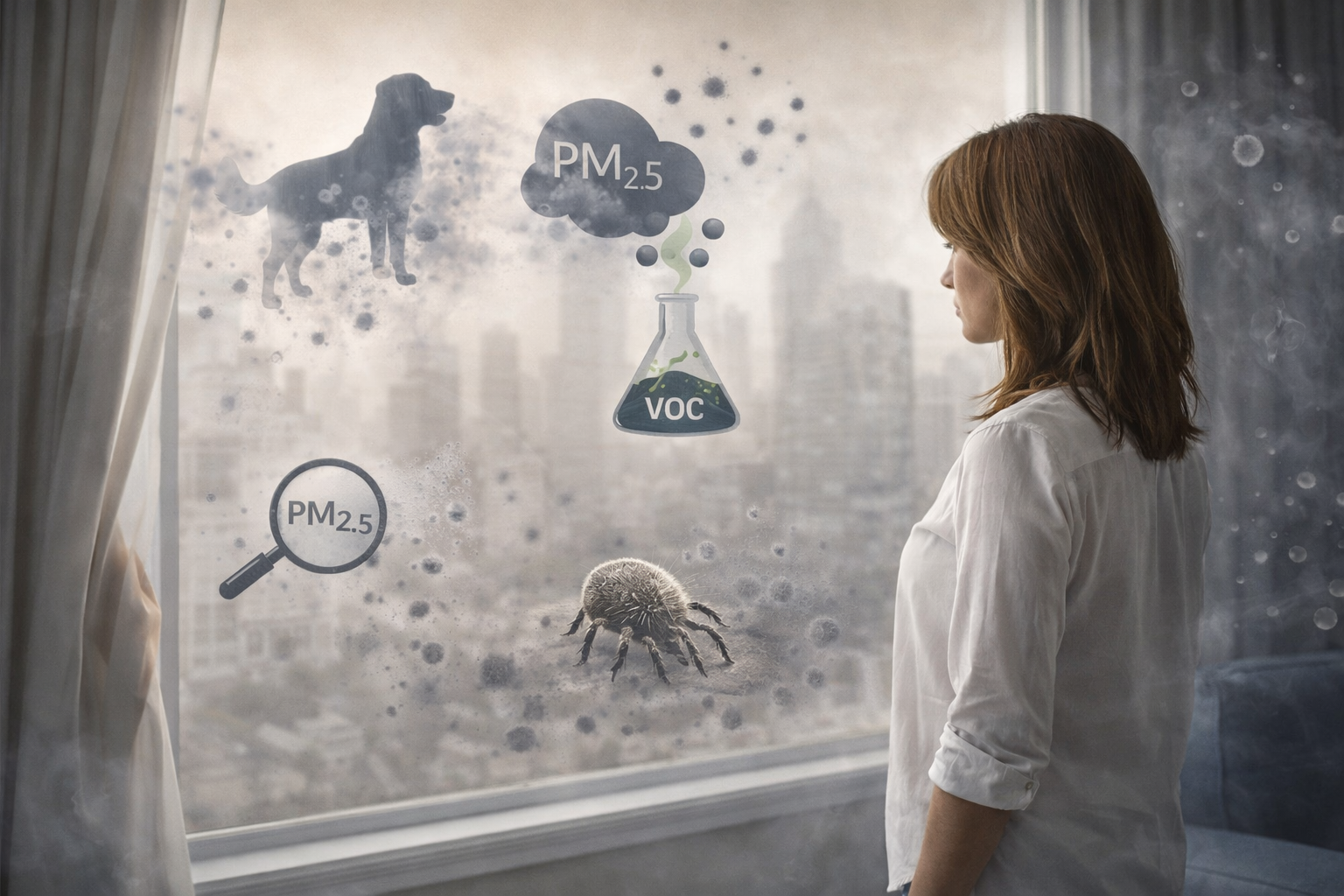
Most people think of air quality as an outdoor problem — smog, wildfire smoke, traffic exhaust. The air inside your home, sealed off from all of that, must be fine. In reality, the opposite is often true. Studies by the U.S. Environmental Protection Agency have found that indoor air can be two to five times more polluted than outdoor air, and in some cases significantly worse. For most adults, who spend roughly 90 percent of their time indoors, that is not a statistic to overlook.
Understanding what is actually in your indoor air — and what it does to you — is the first step toward doing something about it.
The Air Inside Your Home Is More Important Than You Think
Most people think of air quality as an outdoor problem — smog, wildfire smoke, traffic exhaust. The air inside your home, sealed off from all of that, must be fine. In reality, the opposite is often true. Studies by the U.S. Environmental Protection Agency have found that indoor air can be two to five times more polluted than outdoor air, and in some cases significantly worse. For most adults, who spend roughly 90 percent of their time indoors, that is not a statistic to overlook.
Understanding what is actually in your indoor air — and what it does to you — is the first step toward doing something about it.
What Is Actually in Your Indoor Air
Indoor air pollution is not one thing. It is a mixture of particles, gases, biological contaminants, and chemicals, most of which are invisible and odorless.
Particulate matter is the category most people are familiar with, even if not by name. These are tiny airborne particles — dust, skin cells, pet dander, textile fibers, pollen tracked in from outside, and combustion byproducts from cooking. Particles are measured by size in microns. PM10 refers to particles 10 microns or smaller; PM2.5 refers to particles 2.5 microns or smaller. The smaller the particle, the deeper it penetrates into the respiratory system. PM2.5 particles are fine enough to pass through the bronchial tubes and reach the alveoli — the tiny air sacs in the lungs where gas exchange occurs. At that depth, they are no longer merely irritants. They enter the bloodstream.
Volatile organic compounds, or VOCs, are gases released by a wide range of household products and materials. Formaldehyde off-gasses from pressed wood furniture, adhesives, and some flooring. Benzene is present in paints, solvents, and tobacco smoke. Toluene comes from cleaning products and nail polish remover. VOCs are also released during cooking — gas stoves in particular produce nitrogen dioxide and carbon monoxide as combustion byproducts. The list of sources is long, and most homes contain dozens of them simultaneously.
Biological contaminants include mold spores, dust mite allergens, pet dander, and bacteria. Dust mites are worth particular attention: they are microscopic arachnids that live in mattresses, upholstered furniture, and carpets, feeding on shed human skin cells. Their fecal particles are among the most potent indoor allergens known. A single gram of house dust can contain hundreds of thousands of dust mite fecal particles. These particles become airborne when disturbed — during bed-making, vacuuming with a poorly-filtered vacuum, or simply walking across carpet.
Radon is a naturally occurring radioactive gas that enters homes from soil and rock beneath the foundation. It is colorless, odorless, and tasteless. It is also, after smoking, the second leading cause of lung cancer in the United States. The EPA estimates that radon causes approximately 21,000 lung cancer deaths in the U.S. each year. Testing is the only way to know if it is present at dangerous levels in your home.
What Poor Indoor Air Quality Does to Your Health
The health effects of indoor air pollution exist on a spectrum from mild and transient to severe and chronic, depending on the contaminants present, the concentrations, and the duration of exposure.
Short-term effects are often dismissed as something else. Headaches after spending a day in a room with new furniture or fresh paint are often a VOC response. Fatigue, difficulty concentrating, eye irritation, and sore throats are common symptoms of poor indoor air quality that are easily attributed to other causes. The phenomenon is significant enough to have its own name in occupational health research: Sick Building Syndrome.
Allergic and respiratory effects are among the most common chronic consequences of poor indoor air quality. Dust mite allergens, pet dander, and mold spores are the three leading indoor triggers for asthma. In the United States, asthma affects more than 25 million people, and indoor allergens are responsible for a substantial proportion of attacks. Children are disproportionately affected — both because their respiratory systems are still developing and because they spend more time at floor level, where particle concentrations are highest. For children with asthma, the quality of their indoor air is not a comfort issue. It is a clinical one.
Cardiovascular effects are less intuitive but increasingly well-documented. Fine particulate matter (PM2.5) that enters the bloodstream triggers an inflammatory response throughout the body, including in the arteries. Long-term exposure to elevated PM2.5 levels has been associated in population studies with increased rates of heart disease, stroke, and premature death. The cardiovascular burden of indoor air pollution is now considered one of the leading environmental contributors to heart disease globally.
Cognitive effects are an emerging area of research with striking findings. A 2015 study published in the journal Environmental Health Perspectives found that workers in better-ventilated offices with lower CO2 and VOC levels scored significantly higher on cognitive function tests than those in conventional office environments — in some domains, more than twice as high. Subsequent research has reinforced the connection between indoor air quality and performance on tasks requiring complex thinking, crisis response, and focused attention. The mechanism is not fully understood, but CO2 accumulation appears to directly impair the brain's ability to process information, independent of any oxygen deprivation.
The Sources You Can Control
Not all indoor air pollution sources are equally controllable, but many of the most significant ones are.
Flooring and carpets act as a reservoir for particulate matter, allergens, and tracked-in contaminants. Carpet particularly traps and concentrates particles that would otherwise remain airborne for shorter periods. Vacuuming with an unsealed or low-filtration vacuum redistributes fine particles back into the air rather than removing them — a well-documented problem with older or budget vacuum designs. A sealed vacuum system with genuine HEPA filtration removes particles from the home entirely rather than recirculating them.
Cooking is a significant and underappreciated source of indoor air pollution. Gas stoves produce nitrogen dioxide at levels that can, during cooking, exceed outdoor air quality standards. Even electric cooking releases fine particles from cooking oils and heated surfaces. Adequate ventilation — meaning a range hood that actually exhausts air outside the home rather than recirculating it — is the primary mitigation.
Pets contribute dander continuously, not just when visibly shedding. Cat allergens in particular are exceptionally light and persistent — they remain airborne for hours and can be detected in homes that have not had a cat for months. High-efficiency filtration in both vacuum systems and air purifiers makes a measurable difference in dander load.
Humidity is a controllable parameter that profoundly affects biological contaminant growth. Dust mites thrive at relative humidity above 50 percent. Mold grows readily on any surface with sustained moisture. Maintaining indoor relative humidity between 30 and 50 percent significantly limits both. In Utah's dry climate, this is rarely an issue in most seasons — but bathrooms, basements, and tightly sealed modern construction can still create localized high-humidity zones.
Ventilation is the most fundamental control. A home that exchanges air with the outside regularly dilutes the accumulation of VOCs, CO2, and other gaseous contaminants that have no filtration solution. Modern energy-efficient homes are sealed tightly enough that natural air exchange is insufficient — heat recovery ventilators (HRVs) and energy recovery ventilators (ERVs) provide controlled fresh air exchange without the energy penalty of simply opening windows in extreme temperatures.
The Central Vacuum Advantage
Standard portable vacuum cleaners, regardless of how well they filter the air through the unit itself, have a fundamental limitation: the exhaust air is discharged back into the room you are cleaning. Even with a HEPA filter, the disturbed particles that escape the filter — and there will always be some — immediately re-enter your living space. The process of vacuuming with a portable unit measurably increases airborne particle concentrations during and immediately after use.
A central vacuum system eliminates this problem at the source. The dirty airstream is carried through the wall piping to a power unit typically located in a garage, basement, or utility room, and exhausted outside the living area entirely. Particles captured by the system never re-enter the home. For households with allergy sufferers, asthma patients, or anyone who wants to take indoor air quality seriously, this is not a marginal difference — it is a structural one.
A Practical Framework
Improving your indoor air quality does not require a complete renovation. The highest-impact actions, in approximate order of effectiveness, are:
Test for radon. It is inexpensive, takes two to seven days, and addresses a risk that no amount of filtration can mitigate. If levels are elevated, remediation is straightforward and effective.
Vacuum regularly with a sealed, high-filtration system. For homes with carpeting, twice weekly vacuuming with a genuine HEPA system makes a substantial difference in allergen load. For hard floors, high-filtration is equally important — fine particles become airborne more readily from hard surfaces than carpet.
Maintain your HVAC filter. A clogged or low-efficiency filter recirculates particulate matter through your home's air handler. Replace filters on schedule and consider upgrading to a higher MERV rating if your system supports it.
Control humidity. Keep it between 30 and 50 percent. This single intervention limits dust mite populations, mold growth, and VOC off-gassing rates simultaneously.
Ventilate during high-emission activities. Cooking, painting, using cleaning products, and bringing new furniture into the home all introduce pollutants that ventilation can clear. Open windows when conditions allow, and use exhaust ventilation during cooking regardless of season.
Introduce indoor plants with appropriate expectations. The research on plants as air purifiers is often overstated — the volumes of air that household plants can meaningfully filter are small. Their primary value is psychological, not clinical. Do not substitute them for mechanical filtration.
The Bottom Line
The air inside your home is a health variable you have real control over — more control, in many respects, than you have over the air outside. The investment in good filtration, appropriate ventilation, and humidity management pays dividends in respiratory health, sleep quality, cognitive function, and long-term cardiovascular health. For households with children, the elderly, or anyone with respiratory conditions, the stakes are higher still.
Clean air is not a luxury. It is what your lungs expect every time you take a breath — roughly 20,000 times a day, almost entirely indoors.
Swiss Boy Vacuum specializes in central vacuum installation, repair, and parts throughout Utah. Central vacuum systems are among the most effective tools available for reducing indoor particulate load. Visit us in Salt Lake City or browse our products at swissboy.biz.
Comments
Be the first to comment...