

How to Choose a Central Vacuum System for a Large Home
- Posted on
- By Swiss Boy
- 0
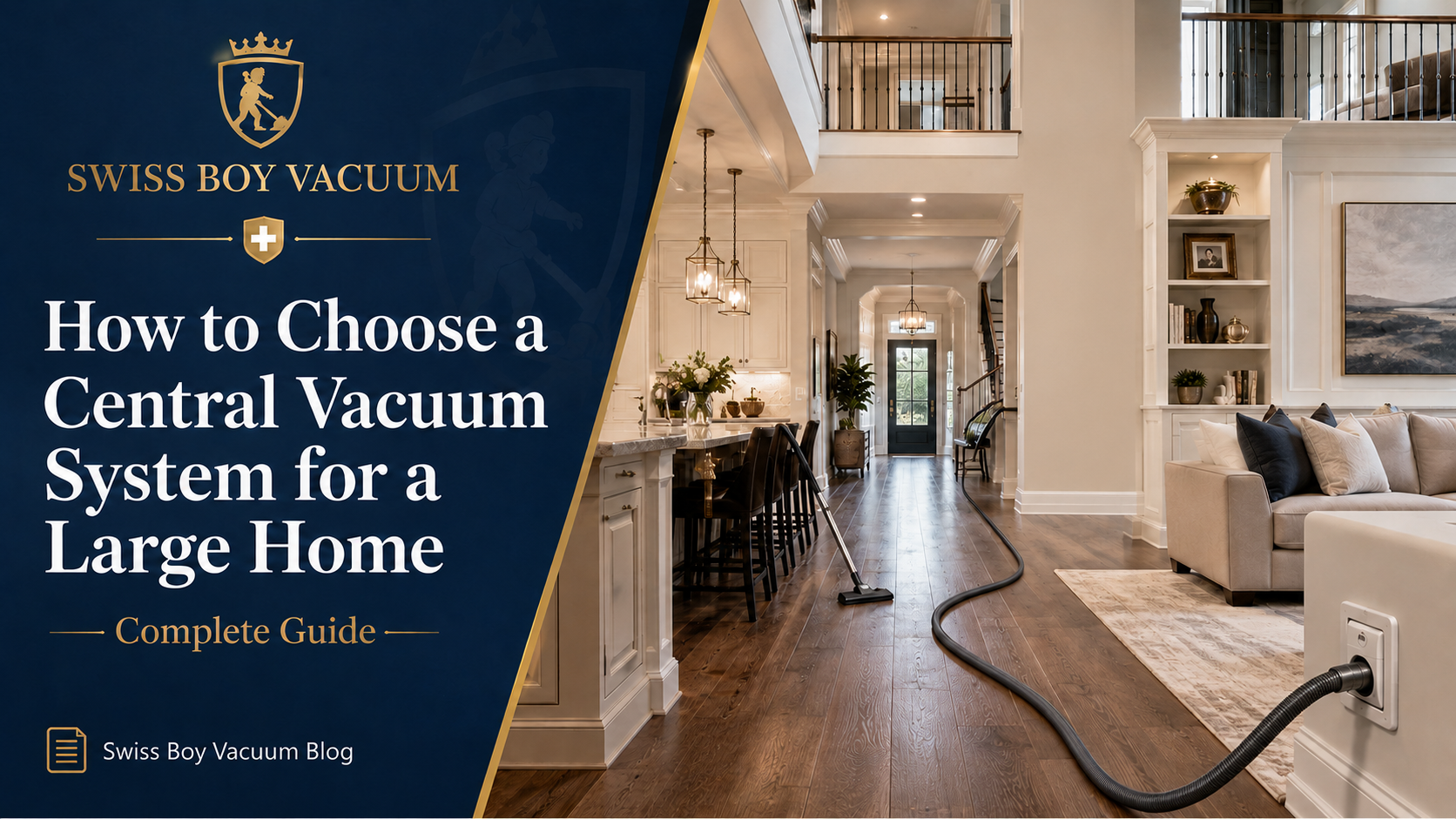
Choosing a central vacuum for a large home requires the right air watts, inlet placement, and motor type. Here's exactly what to look for — and what to avoid.
How to Choose a Central Vacuum System for a Large Home
Picking a central vacuum for a smaller home is fairly straightforward, most quality systems will handle it just fine. But once your home gets above 3,500 or 4,000 square feet, the decisions start to matter a lot more. The wrong system will struggle to maintain suction at your farthest inlets, wear out its motor faster than it should, and leave you frustrated with a $1,500 purchase that underdelivers.
This guide is written specifically for larger homes, 3,500 sq ft and up, and covers the five things that actually matter when you are choosing a system at this size.
1. Match the Power Unit to Your Actual Square Footage
Every central vacuum power unit is rated for a maximum square footage. These ratings are a useful starting point, but they assume a reasonably straightforward pipe layout. In a large home with long pipe runs, multiple floors, or a complex floor plan, suction at the farthest inlet will always be somewhat lower than at the closest one, that is just physics.
The practical rule for large homes: buy a unit rated for at least 20-30% more square footage than your actual home. If you have a 5,000 sq ft home, look at units rated for 6,000-7,000 sq ft or more. That buffer ensures you have strong, consistent suction at every inlet, not just the ones closest to the power unit.
Large Home Central Vacuum Sizing Guide
For larger homes, choose a central vacuum power unit rated above your actual square footage so suction stays strong at the farthest inlet.
| Home Size | Minimum Unit Rating | Recommended Units |
|---|---|---|
| 3,000 – 4,000 sq ft: | 5,000 sq ft rated | VacuFlo DB7000, Beam mid-range |
| 4,000 – 6,000 sq ft: | 7,000 sq ft rated | VacuFlo DB7000 / DB8000 |
| 6,000 – 8,000 sq ft: | 8,000 sq ft rated | VacuFlo DB8000 Dual motor option |
| 8,000+ sq ft: | 12,000 sq ft rated | VacuFlo DB9000 / DB10Max 240V large-home system |
2. Understand Air Watts, But Don't Stop There
Air watts are the most commonly advertised performance number, and they are a useful measurement, but they are not the whole story. Air watts combine airflow (CFM) and suction (water lift) into a single number, and a higher number generally means more cleaning power. For a large home, look for at least 500 air watts; 550-650+ is better.
What matters just as much for a large home is water lift, the measurement of how hard the motor pulls. Water lift determines how well the system maintains suction through long pipe runs. A unit with 158 inches of water lift will push strong suction all the way to your most distant inlet in a way that a lower-lift motor simply cannot, regardless of air watt claims.
Also worth knowing: tangential bypass motors are generally better for large homes than thru-flow motors. In a bypass motor, air flows around the motor rather than through it, which keeps the motor cooler and extends its life significantly under heavy use. Most quality large-home units use bypass motors.
3. Plan Your Inlet Locations Carefully
Inlet placement is one of the most important decisions in a large home installation, and one of the easiest to get wrong. The standard guideline is one inlet per 600-700 sq ft of coverage, but in a large home the layout matters just as much as the square footage.
A few things to plan for specifically in larger homes:
- Each floor needs at least one inlet, and large floors typically need two or more positioned so a 30-foot hose can reach every corner.
- Bedrooms on the same hallway can often share an inlet placed in the hallway, but large master suites may need their own dedicated inlet.
- Consider a garage inlet for vacuuming vehicles, this is one of the most appreciated features in homes with attached garages.
- A VacPan (toe-kick inlet) in the kitchen or mudroom lets you sweep debris directly into the system, very convenient in high-traffic areas.
- If you have an open plan main level, measure carefully, a 30-foot hose covering a great room, kitchen, and dining area may need two inlets positioned at opposite ends.
4. Choose the Right Filtration for Your Household
Large homes tend to accumulate more dust and debris simply because there is more surface area to cover. Filtration matters more at this scale because your motor is handling a higher volume of debris over time.
Bagged systems
The best choice for allergy sufferers and homes with pets. High-quality filter bags, like VacuFlo's CleanShield bags, capture 99.9% of particles including fine allergens. When the bag is full, it seals and is disposed of without releasing dust back into the air. Bags need replacing two to four times per year depending on use.
Cyclonic / bagless systems
Uses centrifugal force to separate dirt and must be vented outside. No bags to buy or replace, but the canister needs to be emptied manually, which can release fine dust if not done carefully outdoors. A good choice if you prefer low ongoing cost and do not have serious allergy concerns.
Self-cleaning filter systems
Some units feature a self-cleaning filter that shakes debris loose automatically. These are very low maintenance and a good middle ground, but make sure the unit is still vented outside or uses a secondary filter to capture fine particles.
5. Think About the Hose System, Especially in a Large Home
In a large home, hauling a 30-foot hose from room to room gets old quickly. There are two upgrades worth knowing about:
Longer hoses
Most systems come with a 30-foot hose, but 35-foot options are available and can reduce the number of inlets needed in large open-plan rooms. A 35-foot hose covers roughly 1,200 sq ft from a single inlet with full range of motion.
Retractable hose systems (Hide-A-Hose)
The ultimate convenience upgrade for large homes. The hose lives inside the wall and pulls out from the inlet when you need it, up to 50 feet, then retracts automatically when you are done. No storage, no carrying, no tangling. If you are building new or doing a major renovation, this is worth serious consideration. The additional cost per inlet is $400-$800, but for a busy large home it genuinely changes the experience of vacuuming.
What to Avoid When Buying for a Large Home
- Undersized units. A builder-grade unit rated for 3,000 sq ft will struggle constantly in a 5,000 sq ft home. Do not cut corners on the power unit.
- Too few inlets. Stretching one inlet to cover an area that really needs two means you are always fighting a too-short hose. Inlets are inexpensive relative to the whole system, plan generously.
- Off-brand or private-label units. Established brands like Beam, VacuFlo, and Intervac have decades of motor reliability behind them. Unknown brands often use lower-grade motors that will not last in a high-demand large-home application.
- Poor power unit placement. The unit should be in a garage, basement, or utility room, not adjacent to a bedroom or home office. Motor sound travels through walls even at low volume.
Let Us Help You Choose the Right System
At Swiss Boy Vacuum, we have helped homeowners across Utah spec central vacuum systems for everything from 1,500 sq ft condos to 10,000+ sq ft custom homes. If you are not sure which unit is right for your home size and layout, we are happy to walk you through it, no pressure, just straight advice.
We carry VacuFlo, Beam, and Intervac power units, along with hoses, Hide-A-Hose retractable systems, and everything you need for installation and ongoing maintenance.
Browse our central vacuum power units or contact us to talk through your project. We are based in Salt Lake City and install throughout Utah.
Comments
Be the first to comment...