

Central Vacuum Systems: How much Do They Cost?
- Posted on
- By Swiss Boy
- 0
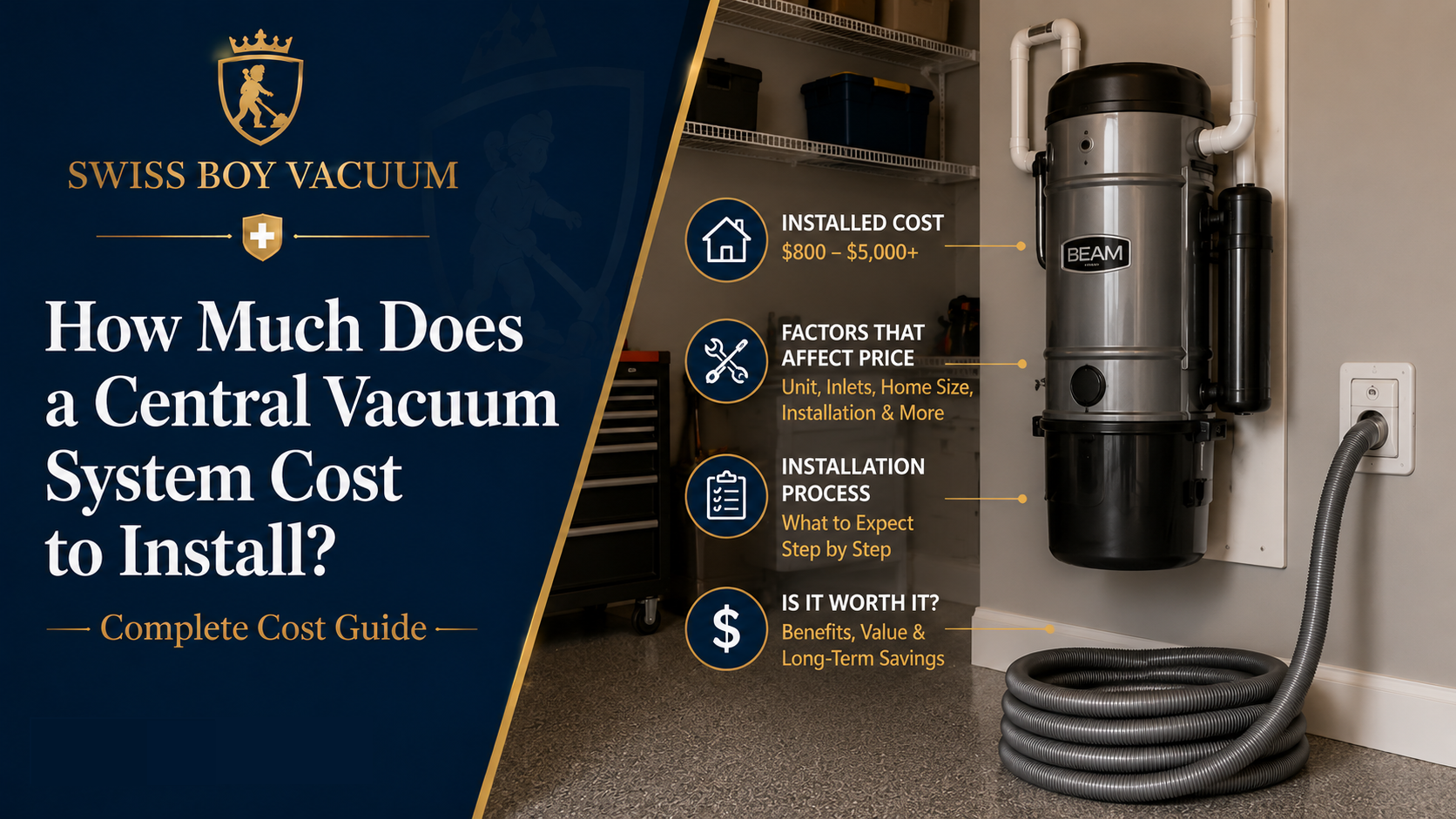
Central vacuum installation costs 800–3,500+ depending on home size. Learn what affects the price and get expert installation in Utah with Swiss Boy Vacuum.
How Much Does a Central Vacuum System Cost to Install?
If you're considering a central vacuum system for your home, the first question is almost always: what's this going to cost me? The honest answer is that it depends on several factors — but the good news is central vacuums are more affordable than most people expect, and they add lasting value to your home. This guide breaks down everything that affects the price so you can plan with confidence.
What Does a Central Vacuum System Cost?
For most homes, the total cost of a central vacuum system — including equipment and professional installation — falls in the range of $800 to $3,500. Here is a rough breakdown:
~ Small homes (under 2,000 sq ft): $800 – $1,400
~ Mid-size homes (2,000 – 4,000 sq ft): $1,200 – $2,200
~ Large homes (4,000 – 8,000 sq ft): $2,000 – $3,500
~ Very large or multi-story homes (8,000+ sq ft): $3,000 – $5,000+
Keep in mind these are installed prices of "Traditional Systems" (Not Retractable Hose Systems) — the power unit, tubing, inlet valves, hose, and labor all included. If you're doing a DIY installation in new construction, you can save significantly on labor.
What Factors Affect the Cost?
1. The Power Unit
The power unit is the heart of the system and the biggest variable in cost. Entry-level units for smaller homes start around $300–$500. Mid-range units for typical 2,000–5,000 sq ft homes run $600–$1,200. Premium dual-motor units for large homes — like the VacuFlo DB8000 — are typically $1,200–$1,800. The key specs to look at are air watts, water lift, and the square footage rating.
2. Number of Inlet Valves
Inlet valves are the wall ports you plug your hose into. Most homes need one inlet per 600–700 sq ft of coverage, so a 2,500 sq ft home typically needs 4–5 inlets. Each inlet — including the tubing, fitting, and cover plate — adds roughly $50–$100 to the material cost, plus labor.
3. New Construction vs. Existing Home
This is the single biggest cost driver. Installing in new construction during the framing stage is straightforward — pipes run inside open walls before drywall goes up, and labor is minimal. Retrofitting an existing home requires routing pipes through finished walls and ceilings, which takes more time and skill. Expect to pay $200–$600 more in labor for a retrofit installation depending on your home's layout.
4. Hose and Attachment Kit
A standard hose and basic attachment set adds $100–$300 to the cost. If you opt for a retractable hose system like the Hide-A-Hose — which installs inside the wall and retracts automatically — expect to add $400–$800 per inlet. It is a premium upgrade but eliminates the hassle of storing and carrying a hose entirely.
5. Brand and System Quality
There is a meaningful difference between budget and quality central vacuum systems. Brands like Beam, VacuFlo, and Intervac are built for 20–30 years of reliable use. Less expensive off-brand systems may cost less upfront but often need motor replacement within 5–10 years. When you factor in longevity, a quality system is usually the better value.
What Does the Installation Process Look Like?
A professional central vacuum installation typically takes 4–8 hours for an average home. Here is what the process looks like:
- The installer maps out the pipe routing and inlet valve locations based on your floor plan.
- PVC tubing is run through walls, floors, or ceilings from each inlet to the power unit location.
- Inlet valves are mounted and wired with low-voltage wire that triggers the unit when the hose is plugged in.
- The power unit is mounted — typically in a garage, basement, or utility room — and connected to the tubing and a 120V outlet.
- The exhaust is vented outside or filtered internally depending on the unit type.
- The system is tested at each inlet and you are walked through how to use it.
In existing homes, the most time-consuming part is routing pipe through finished walls. Experienced installers minimize drywall work by routing through closets, utility spaces, and attic or crawlspace access where possible.
Is It Worth It?
Central vacuums consistently outperform portable vacuums in suction power — typically 3–5 times more powerful — because the motor does not need to be compact or lightweight. They are also significantly quieter at the point of use since the motor is installed away from your living areas. Allergens and dust are exhausted outside or to a remote canister rather than recirculated through the room.
From a resale standpoint, central vacuum systems are a recognized home improvement that adds value — particularly for homes in the $400K+ range where buyers expect premium features. Most real estate agents list it as a positive selling point.
For homeowners who vacuum frequently, have pets, or deal with allergies, a central vacuum typically pays for itself in convenience and air quality within a few years.
Get a Central Vacuum Installed in Utah
Swiss Boy Vacuum has been installing and servicing central vacuum systems in Utah for years. Whether you are building a new home, retrofitting an existing one, or replacing an aging power unit, our team can help you choose the right system and get it installed correctly.
We carry Beam, VacuFlo, Intervac, and Hide-A-Hose systems, and we stock all the parts for ongoing maintenance and repair. Visit our store in Salt Lake City or contact us online to get a quote for your home.
Browse our central vacuum systems at swissboy.biz/central-vacuum-systems or call us to discuss your project.
Comments
Be the first to comment...